Tartuffe Born Again Brothers and Sisters
| Tartuffe | |
|---|---|
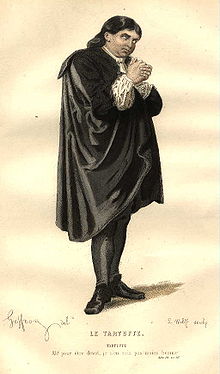 19th-century costume blueprint | |
| Written by | Molière |
| Date premiered | 1664 |
| Original linguistic communication | French |
| Genre | Comedy |
| Setting | Orgon's firm in Paris, 1660s |
Tartuffe, or The Impostor, or The Hypocrite (;[i] French: Tartuffe, ou l'Imposteur, pronounced [taʁtyf u lɛ̃pɔstœʁ]), offset performed in 1664, is a theatrical comedy by Molière. The characters of Tartuffe, Elmire, and Orgon are considered among the greatest classical theatre roles.
History [edit]
Molière performed his first version of Tartuffe in 1664. Nearly immediately following its functioning that same year at Versailles' 1000 fêtes (The Political party of the Delights of the Enchanted Island/Les fêtes des plaisirs de l'ile enchantée), King Louis XIV suppressed it, probably due to the influence of the archbishop of Paris, Paul Philippe Hardouin de Beaumont de Péréfixe, who was the King'due south confessor and had been his tutor.[2] While the king had little personal interest in suppressing the play, he did so because, as stated in the official account of the fête:
although it was constitute to be extremely diverting, the king recognized so much conformity between those that a true devotion leads on the path to heaven and those that a vain ostentation of some skillful works does not prevent from committing some bad ones, that his extreme delicacy to religious matters can not suffer this resemblance of vice to virtue, which could be mistaken for each other; although one does not doubt the good intentions of the author, even so he forbids it in public, and deprived himself of this pleasance, in order not to allow it to be abused by others, less capable of making a just discernment of it.[2] : 76
As a result of Molière's play, contemporary French and English both utilise the word "tartuffe" to designate a hypocrite who ostensibly and exaggeratedly feigns virtue, particularly religious virtue. The play is written entirely in twelve-syllable lines (alexandrines) of rhyming couplets — i,962 lines full.[3]
Characters [edit]
| Grapheme | Description |
|---|---|
| Orgon: Molière | Head of the firm and hubby of Elmire, he is blinded by admiration for Tartuffe. |
| Tartuffe: Du Croisy | Houseguest of Orgon, hypocritical religious devotee who attempts to seduce Elmire |
| Valère: La Grange | The young romantic lead, who struggles to win the hand of his true dear, Orgon'due south daughter Mariane. |
| Madame Pernelle: Louis Béjart, cantankerous-dressed | Mother of Orgon; grandmother of Damis and Mariane |
| Elmire: Armande Béjart-Molière | Wife of Orgon, stride-mother of Damis and Mariane |
| Dorine: Madeleine Béjart | Family housemaid (suivante), who tries to help betrayal Tartuffe and assist Valère and Mariane. |
| Cléante: La Thorillière | Brother of Elmire, brother-in-law of Orgon (the play's raisonneur) |
| Mariane: Mlle de Brie | Girl of Orgon, the fiancée of Valère and sister of Damis |
| Damis: André Hubert | Son of Orgon and blood brother of Mariane |
| Laurent | Servant of Tartuffe (not-speaking character) |
| Argas | Friend of Orgon who was anti-Louis XIV during the Fronde (mentioned but not seen). |
| Flipote | Servant of Madame Pernelle (not-speaking character) |
| Monsieur Loyal: Mr. De Brie | A bailiff |
| A King'due south Officer/The Exempt | An officer of the king |
Plot [edit]
Orgon's family is up in arms because Orgon and his mother take fallen under the influence of Tartuffe, a pious fraud (and a vagrant prior to Orgon'due south help). Tartuffe pretends to be pious and to speak with divine authority, and Orgon and his female parent no longer take any activity without first consulting him.
Tartuffe'due south antics exercise non fool the rest of the family unit or their friends; they detest him. Orgon raises the stakes when he announces that Tartuffe volition marry Orgon'southward girl Mariane (who is already engaged to Valère). Mariane becomes very upset at this news, and the rest of the family realizes how deeply Tartuffe has embedded himself into the family unit.
In an endeavor to show Orgon how awful Tartuffe actually is, the family devises a scheme to trap Tartuffe into confessing to Elmire (Orgon'southward wife) his want for her. As a pious human and a guest, he should have no such feelings for the lady of the firm, and the family hopes that afterwards such a confession, Orgon will throw Tartuffe out of the house. Indeed, Tartuffe does try to seduce Elmire, but their interview is interrupted when Orgon's son Damis, who has been eavesdropping, is no longer able to control his boiling indignation and jumps out of his hiding place to denounce Tartuffe.

Frontispiece and title page of Tartuffe or The Imposter from a 1739 nerveless edition of his works in French and English, printed by John Watts. The engraving depicts the amoral Tartuffe being deceitfully seduced past Elmire, the wife of his host, Orgon who hides under a table.
Tartuffe is at first shocked merely recovers very well. When Orgon enters the room and Damis triumphantly tells him what happened, Tartuffe uses contrary psychology and accuses himself of being the worst sinner:
- Oui, mon frère, je suis un méchant, united nations coupable.
- Un malheureux pécheur tout plein d'iniquité
- Yes, my blood brother, I am wicked, guilty.
- A miserable sinner simply full of iniquity.[4]
Orgon is convinced that Damis was lying and banishes him from the house. Tartuffe even convinces Orgon to order that, to teach Damis a lesson, Tartuffe should be effectually Elmire more than than ever. As a gift to Tartuffe and further penalization to Damis and the rest of his family unit, Orgon signs over all his worldly possessions to Tartuffe.
In a later scene, Elmire challenges Orgon to be witness to a meeting between her and Tartuffe. Orgon, always easily convinced, decides to hide nether a table in the same room, confident that Elmire is wrong. He overhears Elmire resisting Tartuffe's very forward advances. When Tartuffe has incriminated himself definitively and is dangerously close to violating Elmire, Orgon comes out from nether the table and orders Tartuffe out of his business firm. The wily guest means to stay, and Tartuffe finally shows his hand. It turns out that earlier, before the events of the play, Orgon had admitted to Tartuffe that he had possession of a box of incriminating letters (written by a friend, not by him). Tartuffe had taken charge and possession of this box, and now tells Orgon that he (Orgon) will exist the one to leave. Tartuffe takes his temporary leave. Orgon's family tries to decide what to do. Very shortly, Monsieur Loyal shows upwardly with a message from Tartuffe and the court itself; they must exit the firm because it now belongs to Tartuffe. Dorine makes fun of Monsieur Loyal's name, mocking his false loyalty. Even Madame Pernelle, who had refused to believe any ill nearly Tartuffe even in the face of her son's actually witnessing it, has become convinced of Tartuffe's duplicity.
No sooner does Monsieur Loyal get out than Valère rushes in with the news that Tartuffe has denounced Orgon for aiding and assisting a traitor past keeping the incriminating letters and that Orgon is near to be arrested. Before Orgon can flee, Tartuffe arrives with an officer, but to his surprise, the officeholder arrests him instead. The officer explains that the enlightened King Louis 14—who is not mentioned past proper noun—has heard of the injustices happening in the firm and, appalled by Tartuffe's treachery towards Orgon, has ordered Tartuffe'southward arrest instead. Information technology is revealed that Tartuffe has a long criminal history and has often inverse his name to avert beingness caught. As a reward for Orgon'southward previous good services, the king not simply forgives him for keeping the letters but also invalidates the act that gave Tartuffe possession of Orgon's house and possessions. The entire family is thankful that it has escaped the mortification of both Orgon's potential disgrace and their dispossession. The drama ends well, and Orgon announces the upcoming hymeneals of Valère and Mariane. The surprise twist ending, in which everything is set right by the unexpected benevolent intervention of the heretofore unseen king, is considered a notable modern-day case of the classical theatrical plot device deus ex machina.
Controversy [edit]
Though Tartuffe was received well past the public and even by Louis XIV, information technology immediately sparked conflict amongst many dissimilar groups who were offended past the play'due south portrayal of someone who was outwardly pious but fundamentally mercenary, lecherous, and deceitful; and who uses their profession of piety to prey on others. The factions opposed to Molière's work included part of the hierarchy of the French Roman Catholic Church, members of upper-form French order, and the illegal hole-and-corner organization called the Compagnie du Saint-Sacrement. Tartuffe 'south popularity was cutting short when the archbishop of Paris Péréfixe issued an edict threatening excommunication for anyone who watched, performed in, or read the play. Molière attempted to assuage church building officials by re-writing his play to seem more secular and less critical of organized religion, but the archbishop and other leading officials would not budge. The revised, second version of the play was called L'Imposteur and had a main character named Panulphe instead of Tartuffe, the only performance of which occurred in the Palais-Regal theatre on 5 August 1667. Immediately the post-obit twenty-four hours, on 6 August, every bit the king was away from Paris, Guillaume de Lamoignon, first president of the Paris Parlement, censored public performances.[v] Fifty-fifty throughout Molière's conflict with the church, Louis Xiv continued to support the playwright; it is possible that without the King'south back up, Molière might accept been excommunicated. Although public performances of the play were banned, individual performances for the French aristocracy did occur.[6] In 1669, after Molière's detractors lost much of their influence, he was finally allowed to perform the final version of his play. Still, due to all the controversy surrounding Tartuffe, Molière by and large refrained from writing such incisive plays as this one over again.[vii]
An ally of Molière (believed by Robert McBride to be François de La Mothe Le Vayer, but a hotly-debated point)[8] [9] responded to criticism of Tartuffe in 1667 with a Lettre sur la comédie de 50'Imposteur. The bearding author sought to defend the play[a] to the public by describing the plot in particular and so rebutting 2 mutual arguments made for why the play was banned. The starting time beingness that theatrical works should not discuss religion at all; the second being that Tartuffe'south actions on stage, followed by his pious speech, would make the audition think that they were to act equally Tartuffe did. This department of letter contradicts the latter past describing how Tartuffe's actions are worthy of ridicule, in essence comic, and therefore by no means an endorsement.
The comic is the outward and visible form that nature'southward compensation has attached to everything unreasonable, so that we should see, and avoid it. To know the comic we must know the rational, of which it denotes the absence and we must see wherein the rational consists ... incongruity is the middle of the comic ... information technology follows that all lying, disguise, adulterous, dissimulation, all outward bear witness different from the reality, all contradiction in fact between deportment that proceed from a single source, all this is in essence comic.[10]
Centuries later, when the satirical anticlerical mag La Calotte started publication in 1906, its first editorial asserted that Laughter is the only weapon feared by the soldiers of Tartuffe; the new magazine proposed to finer deploy that weapon, with articles and cartoons mercilessly lampooning the Catholic Church building and its clergy.[eleven] [12] [xiii]
Product history [edit]
The original version of the play was in three acts and was start staged on 12 May 1664 at the Palace of Versailles' Cour de Marbre[14] as part of festivities known equally Les Plaisirs de l'île enchantée. Because of the attacks on the play and the ban that was placed on it, this version was never published, and no text has survived, giving rise to much speculation equally to whether information technology was a piece of work in progress or a finished piece. Many writers believe it consisted of the start 3 acts of the final version, while John Cairncross has proposed that acts 1, 3, and 4 were performed.[15] Although the original version could not be played publicly, information technology could exist given privately,[xv] and it was seen on 25 September 1664 in Villers-Cotterêts, for Louis' brother Philippe I, Knuckles of Orléans, aka Monsieur and 29 November 1664 at the Château du Raincy, for the veteran of the Fronde, Armand de Bourbon, Prince of Conti.[16]
The 2d version, L'Imposteur, was in five acts and performed merely once, on 5 August 1667 in the Théâtre du Palais-Royal. On 11 Baronial, before whatever additional performances, the Archbishop of Paris Péréfixe banned this version also. The largely-final, revised third version in five acts, nether the championship Tartuffe, ou Fifty'Imposteur, appeared on 5 February 1669 at the Palais-Royal theatre and was highly successful.[fifteen] This version was published[17] and is the 1 that is generally performed today.[15]
Modernistic productions [edit]
Since Molière's fourth dimension, Tartuffe has stayed on the repertoire of the Comédie-Française, where it is its most performed play.[18]
The Russian theatre practitioner Constantin Stanislavski was working on a production of Tartuffe when he died in 1938. It was completed by Mikhail Kedrov and opened on 4 December 1939.[nineteen]
The first Broadway product took place at the ANTA Washington Square Theatre in New York and ran from fourteen January 1965 to 22 May 1965. The cast included Hal Holbrook equally M. Loyal, John Phillip Law every bit King'south Officer, Laurence Luckinbill equally Damis and Tony Lo Bianco equally Sergeant.
The National Theatre Company performed a production in 1967 using the Richard Wilbur translation and featuring John Gielgud every bit Orgon, Robert Stephens as Tartuffe, Jeremy Brett as Valere, Derek Jacobi as The Officeholder and Joan Plowright equally Dorine.[20]
A production of Richard Wilbur'southward translation of the play opened at the Circle in the Square Theatre in 1977 and was re-staged for television set the post-obit year on PBS, with Donald Moffat replacing John Wood equally Tartuffe, and co-starring Tammy Grimes and Patricia Elliott.
Charles Randolph-Wright staged a production of Tartuffe, July 1999, at American Solarium Theater in San Francisco, which was set up among affluent African Americans of Durham, North Carolina, in the 1950s.[21]
A translation past Ranjit Commodities was staged at London'south Playhouse Theatre in 1991 with Abigail Cruttenden, Paul Eddington, Jamie Glover, Felicity Kendal, Nicholas Le Prevost, John Sessions and Toby Stephens.[22] Bolt's translation was later staged at London'south National Theatre in 2002 with Margaret Tyzack as Madame Pernelle, Martin Clunes every bit Tartuffe, Clare Holman as Elmire, Julian Wadham as Cleante and David Threlfall as Orgon.[23]
David Ball adjusted Tartuffe for the Theatre de la Jeune Lune in 2006 and Dominique Serrand revived this production in 2015 in a coproduction with Berkeley Repertory Theatre, South Coast Repertory and the Shakespeare Theatre Company.[24]
Liverpudlian poet Roger McGough's translation premièred at the Liverpool Playhouse in May 2008 and transferred subsequently to the Rose Theatre, Kingston.[25]
Adaptations [edit]
Motion-picture show [edit]
- The picture Herr Tartüff was produced by Ufa in 1926. Information technology was directed by F. Due west. Murnau and starred Emil Jannings as Tartuffe, Lil Dagover every bit Elmire and Werner Krauss as Orgon.
- Gérard Depardieu directed and starred in the title part of Le tartuffe, the 1984 French moving-picture show version.
- The 2007 French moving-picture show Molière contains many references, both directly and indirect, to Tartuffe, the most notable of which is that the character of Molière masquerades as a priest and calls himself "Tartuffe". The end of the film implies that Molière went on to write Tartuffe based on his experiences in the film.
Phase [edit]
- The National Theatre, England, adapted this for stage in 1967 at The Erstwhile Vic Theatre, London. Translated by Richard Wilbur, directed by Tyrone Guthrie and ran for 39 performances, closing in 1969.[26]
- Tartuffe in Texas is set in Dallas, Texas; published in 2012 by Eldridge Publishing.[27]
- Bell Shakespeare Company, Tartuffe - The Hypocrite translated from original French past Justin Fleming in 2014 and earlier for Melbourne Theatre Company in 2008, with uniquely varied rhyming verse forms.
- American Stage Theatre Company in St. Petersburg, Florida, adapted Tartuffe in 2016, staged in modern-solar day as a political satire, with Orgon, equally a wealthy American man of affairs who entrusts his reputation and his fortune to up-and-coming politician, Tartuffe.[28]
- Information technology was adjusted for an Australian audience in the "mail service-truth" historic period[29] by playwright Philip Kavanagh, performed by the State Theatre Company of South Commonwealth of australia and Brink Productions, October–November 2016 in Adelaide.[thirty]
- An accommodation in English rhyming couplets set in London in 2017 past Andrew Hilton and Dominic Ability, premiered past Shakespeare at the Tobacco Factory and Tobacco Factory Theatres in Bristol, April–May 2017. Tartuffe a bogus business guru preying on quondam-school Tory politician in mid-life crisis.[ commendation needed ]
Television [edit]
- Productions for French television were filmed in 1971, 1975, 1980, 1983 and 1998.
- On 28 November 1971, the BBC broadcast every bit part of their Play of the Calendar month series a production directed by Basil Coleman using the Richard Wilbur translation and featuring Michael Hordern as Tartuffe, Mary Morris as Madame Pernelle and Patricia Routledge every bit Dorine.[31]
- Donald Moffat starred in a 1978 videotaped PBS television production with Stefan Gierasch as Orgon, Tammy Grimes equally Elmire, Ray Wise as Damis, Victor Garber as Valère and Geraldine Fitzgerald equally Madame Pernelle. The translation was by Richard Wilbur and the production was directed by Kirk Browning. Taped in a idiot box studio without an audience, it originated at the Circumvolve in the Square Theatre in New York in 1977, merely with a slightly unlike cast – John Wood played Tartuffe in the Broadway version, and Madame Pernelle was played by Mildred Dunnock in that same production.
- The BBC adapted the Beak Alexander production for the Royal Shakespeare Company. This television version was first screened in the United kingdom during Nov 1985 in the Theatre Dark serial with Antony Sher, Nigel Hawthorne and Alison Steadman reprising their phase roles (see "Modern Productions" above). While this television version does derive from the RSC'due south 1983 stage production, IMDb is inaccurate in dating this videotaped version from that year. The BFI Picture show & Tv Database indicates the start date for this programme's production was in 1984, while the copyright date is for 1985.[32]
Opera [edit]
- The composer Kirke Mechem based his opera Tartuffe on the play.
Audio [edit]
- On 10 December 1939, an 60 minutes-long adaptation was broadcast on the NBC radio series Great Plays.
- In 1968, Caedmon Records recorded and released on LP (TRS 332) a production performed that same yr by the Stratford National Theatre of Canada as role of the Stratford Festival (see "Stratford Shakespeare Festival production history") using the Richard Wilbur translation and directed by Jean Gascon. The cast included Douglas Rain as Orgon and William Hutt every bit Tartuffe.
- In 2009, BBC Radio 3 broadcast an adaptation directed past Gemma Bodinetz and translated by Roger McGough, based on the 2008 Liverpool Playhouse production (run across "Modernistic Productions" above), with John Ramm as Tartuffe, Joseph Alessi equally Orgon, Simon Coates as Cleante, Annabelle Dowler as Dorine, Rebecca Lacey as Elmire, Robert Hastie every bit Damis and Emily Pithon as Marianne.[33]
- Fifty.A. Theatre Works performed and recorded a production in 2010 (ISBN 1-58081-777-7) with the Richard Wilbur translation and featuring Brian Bedford as Tartuffe, Martin Jarvis equally Orgon. Alex Kingston equally Elmire and John de Lancie as Cleante.
Notes [edit]
- ^ the 2nd version, before the largely-finished 3rd version in 1669
References [edit]
- ^ "Tartuffe". Random Firm Webster's Unabridged Lexicon.
- ^ a b Rey, François; Lacouture, Jean (2007), Molière et le roi, éditions du seuil
- ^ Molière (2002). Tartuffe. Translated by Martin Sorrel. London: Nick Hern Books.
- ^ Molière. Tartuffe. Three.vi.
- ^ Prest, Julia (2016). "Failed Seductions and the Female person Spectator: Pleasance and Polemic in the Lettre sur la comédie de l'Imposteur". Yale French Studies. 130: x–23. JSTOR 44512289.
- ^ Pitts, Vincent J. (2000). La Grande Mademoiselle at the Court of France: 1627—1693. Baltimore: Johns Hopkins University Press. p. 250. ISBN0-8018-6466-6.
- ^ Pavlovski, Linda, ed. (2001). "Molière: Introduction". Drama Criticism (2006 ed.). Gale Group, Inc. 13 . Retrieved 26 November 2007 – via eNotes.com.
- ^ McBride, Robert (2005). Moliere Et Son Premier Tartuffe. Manchester University Press. ISBN0907310575.
- ^ Prest, Julia (2016). "Failed Seductions and the Female Spectator: Pleasance and Polemic in the Lettre sur la comédie de fifty'Imposteur". Yale French Studies. 130: xi. JSTOR 44512289.
Scholars have been ho-hum to have this attribution, however, and other names that are commonly put frontward are Jean Donneau de Visé and Claude- Emmanuel Huillier, better known equally Chapelle.
- ^ "Molière". Encyclopædia Britannica. 2007. Retrieved 4 December 2007.
- ^ La Calotte at Gallica
- ^ Almanach de La Calotte at Gallica
- ^ La Calotte at caricaturesetcaricature.com
- ^ "Versailles: The Cour de Marbre". 6 Feb 2017.
- ^ a b c d Koppisch 2002.
- ^ Garreau 1984, vol. 3, p. 417.
- ^ Molière 1669.
- ^ Engelberts, Matthijs (2018), "Molière's Tartuffe and French National Identity: Reconfiguring the King, the People and the Church building", Reconsidering National Plays in Europe, Springer International Publishing, pp. 211–243, doi:ten.1007/978-iii-319-75334-8_8, ISBN9783319753331
- ^ Benedetti (1999, 389).
- ^ "Tartuffe: National Theatre. Translated by Richard Wilbur". Theatricalia.com. 21 November 1967. Retrieved xiv Dec 2016.
- ^ Shirley, Don (five July 1999). "Fresh, Clever 'Tartuffe' Hits New Heights". Los Angeles Times. San Francisco. Retrieved 4 April 2022.
- ^ "Tartuffe: Translation by Ranjit Commodities". Theatricalia.com . Retrieved 14 December 2016.
- ^ "Product of Tartuffe". Theatricalia.com . Retrieved xiv Dec 2016.
- ^ "Berkeley Rep Presents Tartuffe" (PDF). Berkeleyrep.org . Retrieved 14 December 2016.
- ^ Key, Philip (xv May 2008). "Tartuffe, Roger McGough, Liverpool Playhouse". Liverpool Daily Mail service.
- ^ "Tartuffe". National Theatre. Retrieved xx May 2017 – via catalogue.nationaltheatre.org.united kingdom.
- ^ "Eldridge Plays & Musicals". Histage.com . Retrieved 14 Dec 2016.
- ^ "Tartuffe". americanstage.org. American Stage Theatre Company. Retrieved 14 December 2016.
- ^ Brooker, Ben (xi November 2016). "Tartuffe". australianbookreview.com.au. Australian Book Review.
- ^ "Review: Tartuffe". The Adelaide Review. ix November 2016.
- ^ "BBC Play of the Month (1965–1983) : Tartuffe". IMDb.com . Retrieved fourteen December 2016.
- ^ "Tartuffe Or the Imposter (1985)". ftvdb.bfi.org.uk. British Film Institute. Archived from the original on 29 January 2009. Retrieved 14 December 2016.
- ^ "Drama on three, Tartuffe". BBC.co.uk. BBC Radio 3. 24 July 2016. Retrieved 14 December 2016.
Sources [edit]
- Benedetti, Jean. 1999. Stanislavski: His Life and Fine art. Revised edition. Original edition published in 1988. London: Methuen. ISBN 0-413-52520-ane.
- Garreau, Joseph E. (1984). "Molière", vol. 3, pp. 397–418, in McGraw-Hill Encyclopedia of Globe Drama, Stanley Hochman, editor in principal. New York: McGraw-Hill. ISBN 9780070791695.
- Koppisch, Michael S. (2002). "Tartuffe, Le, ou l'Imposteur", pp. 450–456, in The Molière Encyclopedia, edited by James F. Gaines. Westport, Connecticut: Greenwood Printing. ISBN 9780313312557.
- Molière (1669). Le Tartuffe ou l'Imposteur. Paris: Jean Ribov – via Gallica.
- Brockett, Oscar. 1964. "THE THEATER, an Introduction" published Holt, Rhinehart, and Winston. Inclusive of University of Iowa production, "Tartuffe", includes "The Set up Designer", ready design and Thesis, a 3 hundred year commemoration, "A Project in Scene Design and Stage Lighting for Moliere's Tartuffe", by Charles M. Watson, State Academy of Iowa, 1964.
- The Misanthrope and Tartuffe by Molière, and Richard Wilbur 1965, 1993. A Harvest Book, Harcourt, Caryatid and Visitor, New York.
- The Misanthrope, Tartuffe, and other Plays, by Molière, and Maya Slater 2001, Oxfords World Classics, Oxford University Printing, Clays Ltd. 2008
External links [edit]
 | Wikiquote has quotations related to Tartuffe . |
 | Wikimedia Commons has media related to Tartuffe. |
- Tartuffe at Standard Ebooks
- Costless Project Gutenberg etext of Tartuffe (in modern English verse)
- Tartuffe (original version) with approx. thousand English annotations at Tailored Texts
-
 Tartuffe public domain audiobook at LibriVox
Source: https://en.wikipedia.org/wiki/Tartuffe
0 Response to "Tartuffe Born Again Brothers and Sisters"
Post a Comment